Case Studies
This page provides a selection of project examples covering all of our disciplines:
Noise, Vibration & Building Acoustics
ACCON UK Limited were commissioned to carry out a Noise Impact Assessment for a proposed residential development on Essex Street, Birmingham. The project faced many challenges such as noisy road traffic and a nightclub located opposite the development. ACCON UK carried out a detailed assessment and provided input and advice to inform the building design and mitigation. The planning application was approved by the Council in September 2020 after months of dedicated work by our experienced team.
Sir Joseph Williamson’s Mathematical School
ACCON carried out detailed acoustic assessments for the final technical design (RIBA Stage 4) for a new maths block at a secondary school. Assessments of sound insulation, reverberation times and noise from ventilation systems were carried out and these demonstrated compliance with the performance standards required by BB93.
ACCON carried out a Noise Impact assessment to ensure planning conditions relating to noise were satisfied. The project involved detailed sound insulation assessments and predictions for a development comprising of 131 residential units.
Industrial Noise – Wolverhampton
Assessment of industrial noise from a supplier of fasteners to a proposed residential development. Our experienced staff also identified another prominent noise source affecting the site that had been over-looked by a previous consultant.
Wind Turbine Noise – East Ayrshire & South Ayrshire Councils
ACCON provide advice on noise from wind turbines to East Ayrshire Council and South Ayrshire Council. This involves carrying out detailed technical reviews of the noise assessments submitted in support of planning applications for on-shore wind farms and advising on planning conditions with respect to noise.
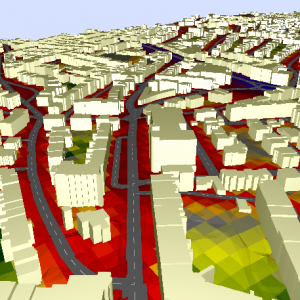
Noise, vibration and air quality assessments and associated chapters for the Environmental Statement for the proposed BX-D Luas tram line in Dublin. Major efficiencies on modelling time and the time taken to test the impacts of various intervention strategies were achieved by running the noise and air pollution concentration modelling within the same model. An assessment of the noise and air quality impacts of the construction activities was also carried out, including recommendations for mitigation measures. This work then led to Graham Parry (ACCON Managing Director) providing evidence at an Oral Hearing.
Detailed noise at work and hand arm vibration assessment for a ground-breaking company. Mitigation and management measures were suggested by ACCON, including identification of appropriate hearing protection, a review of working practices and a programme of health surveillance for all at risk employees.
ACCON UK Managing Director Graham Parry presented evidence at Public Inquiry on behalf of Wealden District Council (WDC) in respect of noise to support the Council’s decision to refuse planning permission for a food store within the market area in Hailsham. The appellant’s appeal was refused by the Planning Inspectorate who upheld the original decision of WDC.
ACCON Acoustic Consultants identified a number of concerns when review a previous noise assessment of proposals to modernise a metal recycling facility for end of life vehicles. ACCON undertook our own noise assessment, including noise prediction using a noise model, of proposed plant.
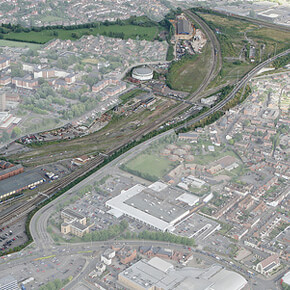
Assessments for noise, air quality and contaminated land for the Masterplan in relation to the redevelopment of the Greater Railway Triangle Area to determine to what extent the impacts of these factors constrained the proposed residential development of the site. The noise assessment looked at noise from road and rail sources using noise modelling (CadnaA) software, including assessment of the efficacy of various potential mitigation measures.
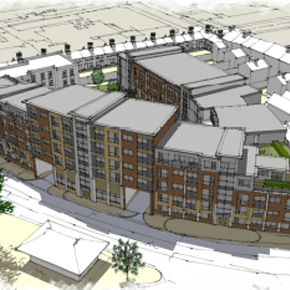
Noise and air quality assessments for a proposed hotel and residential units, including noise and air quality modelling. The road noise source was modelled using CadnaA noise software in order to clarify the distance attenuation and the shielding effects of the hotel building upon the noise levels at the proposed residential units. Mitigation options were also reviewed and the planning application was granted.
ACCON prepared numerous Section 61 consent applications across a number of London Boroughs for a various contractors working on the Crossrail project. The work included: background noise measurements; prediction of noise levels at noise sensitive receptors; advice on noise mitigation measures, noise monitoring; and vibration monitoring to identify risks of building damage.
Noise, air quality and daylight assessments for the proposed redevelopment of land for residential use.
Flood risk, noise and air quality assessments for the proposed redevelopment of land for residential use. Due to spatial constraints on site, mitigation measures were limited to suggestion of double glazing and alternative ventilation.
Air Quality
The purpose of the air quality assessment was to determine to what extent air pollution constrained the proposed healthcare development and to assess the impact of the development upon local air pollution. ACCON UK completed detailed modelling of the pollutants at height. This determined that the whole building could be supplied with clean air by locating inlets for the ventilation system within the internal courtyard of the development at second floor level.
ACCON UK carried out a comprehensive air quality assessment for the Darul Ummah School in Bigland Street, London. The school was due to be demolished and subsequently redeveloped. Detailed air quality assessments considered the overall levels of pollutant concentrations to determine the potential constraints on the development. A risk assessment of the generation of dust and fine particulates during demolition and construction was also carried out.
The BX-D Tramline Extension in Dublin City Centre required extensive air quality modelling that involved close collaboration with project partners. Traffic modelling was reviewed along with transportation assessments in order to derive appropriate inputs for air quality modelling. ACCON’s managing director provided evidence at the Oral Hearing.
This development within Bedford involved the construction of a new Specialist Residential Care scheme where air quality was a priority concern. The development is sited within an Air Quality Management Area and therefore an assessment was required to ensure that hydrocarbons, nitrogen dioxide and particulates would not exceed air quality limits.
Gloucester Road Railway Triangle
ACCON UK completed a range of environmental assessments for the Masterplan for this development. It was particularly important to provide robust air quality and noise assessments at the early design stage to maximise the developable areas while maintaining good environmental conditions for future residents. ACCON was able to determine to what extent noise, air quality and contaminated land issues constrained the proposed residential development.
ACCON UK carried out a comprehensive noise and air quality assessment for a proposed hotel and residential units within the London Borough of Brent. Extensive air quality modelling was required to facilitate an assessment of the overall levels of hydrocarbons around the site. Local air quality monitoring was used to verify model results and ensure the model was not under or over predicting particulate levels. ACCON’s work contributed to the success of the planning application.
ACCON UK carried out air quality assessments for the proposed redevelopment of land on the Pronto Trading Estate on Uxbridge Road. The purpose of these assessments was to ascertain any constraints on the development due to air quality issues. Impacts due to generated traffic were also assessed with regards to overall levels of pollutants in the area post-development.
Light
An Independent lighting appraisal to address lighting pollution concerns from proposed flood lit tennis courts at Braunton School and Community College. Detailed modelling was carried out using Calculux software and the manufacturer’s photometric data and the average court surface illuminance, light overspill and vertical illuminance were calculated with the impact compared to the appropriate Environmental Zone.
Daylight, sunlight and overshadowing calculations in accordance with the BRE guidelines.
Flood Risk
A Flood Risk Assessment identified that the development would lie within Zone 3 (high probability of flooding) according to the Environment Agency Flood Map. The depth of flood water in a 1 in 100 year flood was determined likely to be 100 mm or less, however the development would be raised 300 mm above ground level. In addition, the development would not exacerbate the flood risk downstream due to an existing flood compensation scheme. Accordingly, it was deemed that the development has passed the Exception Test and is therefore appropriate for the development site area.
Flood risk assessment for the proposed extension of an existing residential property. It was established that the site is located within ‘Flood Zone 3’, which is an area which has a 1 in 100 chance of being flooded by a river each year. Mitigation was proposed that involved recommendations for floor levels.
Ecology
An Appropriate Assessment was required due to the proximity of the development to a Special Protection Area (SPA) under the Birds Directive (79/409/EEC). Potential adverse effects on the SPA were identified and recommendations were made for mitigation.
Contaminated Land
This Phase 1 contaminated land study involved a land quality risk assessment of the proposed re-development at Southgrove Farm, Burbage, Wiltshire. ACCON undertook a full desk top survey of relevant historic data and used the geological information to develop a preliminary Conceptual Model of the site which identified all potential and actual contaminants, receptors and pathways (pollution linkages).